
Why translating your content isn't enough: lessons from UKG's multilingual marketing machine
How UKG runs content across five languages, why translation is only the start, and why product messaging that converts in London can backfire in Berlin

This post is based on a conversation with Rémi Malenfant, former Brand, Communications & Content Director EMEA at UKG, recorded as part of Weglot’s International Marketing Summit.
Most marketing teams treat going international as a translation problem. Get the words into the right language, swap in some local stats, maybe update the customer logos, poof! You’re done and ready to launch.
Rémi Malenfant, who ran brand and communications for UKG across EMEA, would disagree. Strongly.
UKG is a $4 billion HR technology company, formed through the 2020 merger of Ultimate Software and Kronos and layered with a series of European acquisitions since. Managing content across English, French, German, Dutch, and Spanish, with all the cultural complexity that comes with that, has given Rémi a hard-won perspective on what international content actually requires.
It involves a lot more work than most marketing teams realize, but when conversions from your target countries start rolling in, you’ll see that it was well worth the effort.
Why “just translate it” never works
The assumption is that localization is a technical problem: take an asset, run it through a process, check it, publish it. Done.
But Rémi’s view is that this approach misses the real challenge, which isn’t linguistic, but structural. The way people expect to receive information varies significantly from culture to culture.
So if your content is built around one cultural logic and delivered to an audience operating on a different one, it won’t land, no matter how accurate the translation. It’s a strategy set up to fail from the beginning.
His framework, which he credits to Erin Meyer’s book The Culture Map, centers on the idea of high-context versus low-context communication cultures, and what that means in practice for how you build an argument.
Three countries, three completely different content structures
One thing many teams get wrong is using their American-targeted content and using that as the base for everything else.
But American content, Rémi observes, is built around message reinforcement. The structure is essentially: I’m going to tell you something, here’s me telling you it. By the way, I just told you that. For a US content marketer, this feels like clarity and emphasis, making sure the message unmistakably lands in your brain, gets all nice and comfy.
Not so much for a European reader. It reads as repetitive, like bashing them on the head with your point. For a German reader in particular, it can come across as patronizing. They heard you the first time, and they might not stick around long enough for the second.
German audiences, in Rémi’s experience, want to be convinced before they’re concluded. Open with data. Present your proof points. Build the argument methodically, then arrive at the conclusion. An ebook for a German audience about, say, what makes a great workplace would lead with 15 survey findings before making any claim about what those findings mean. The evidence comes first; the message follows from it.
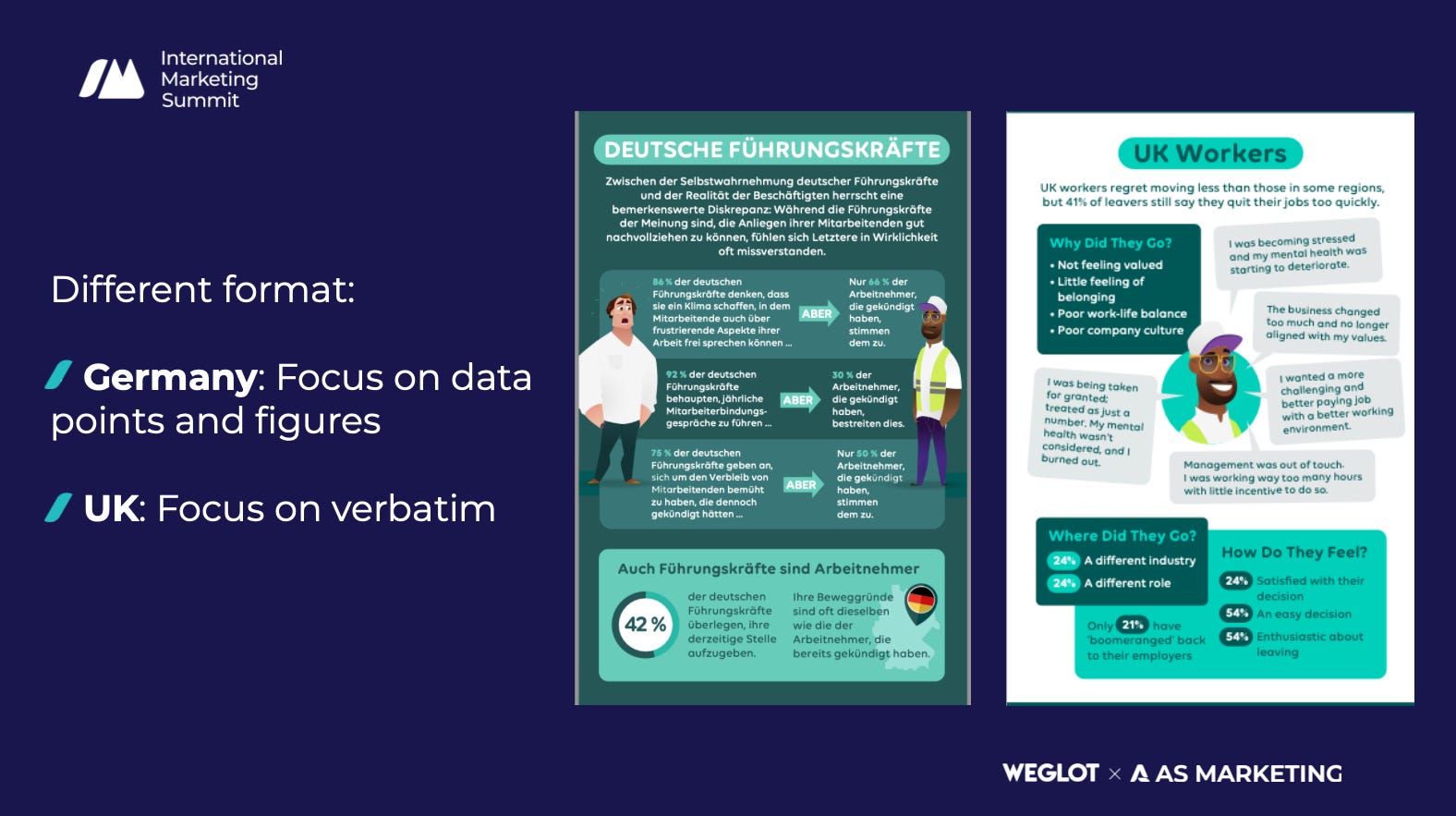
British audiences are almost the inverse. They want the conclusion first: what’s the point, what are you arguing? If you succeed in capturing their interest, they’ll follow you into the supporting evidence. Give them the story before relaying the stats; grab their attention before showing them the proof.
The same content, structured the same way, will feel natural to one audience and completely wrong to another. What “attention grabbing” means in London is not what it means in Singapore.
The funnel is cultural, too
This logic doesn’t just affect individual assets, but the entire marketing funnel sequence.
UKG’s standard approach in most markets is to lead with thought leadership: a survey, an ebook, an educational piece about a broader topic. You build trust and awareness first, then move down the funnel toward product and proof points.
Rémi flips this around in Germany. German buyers want to see your credentials and your customers’ results before they’ll engage with your ideas. So UKG leads with case studies and product proof points: here’s what we do, here’s who we’ve done it for; and only later introduces the broader thought leadership layer. The funnel runs backwards.
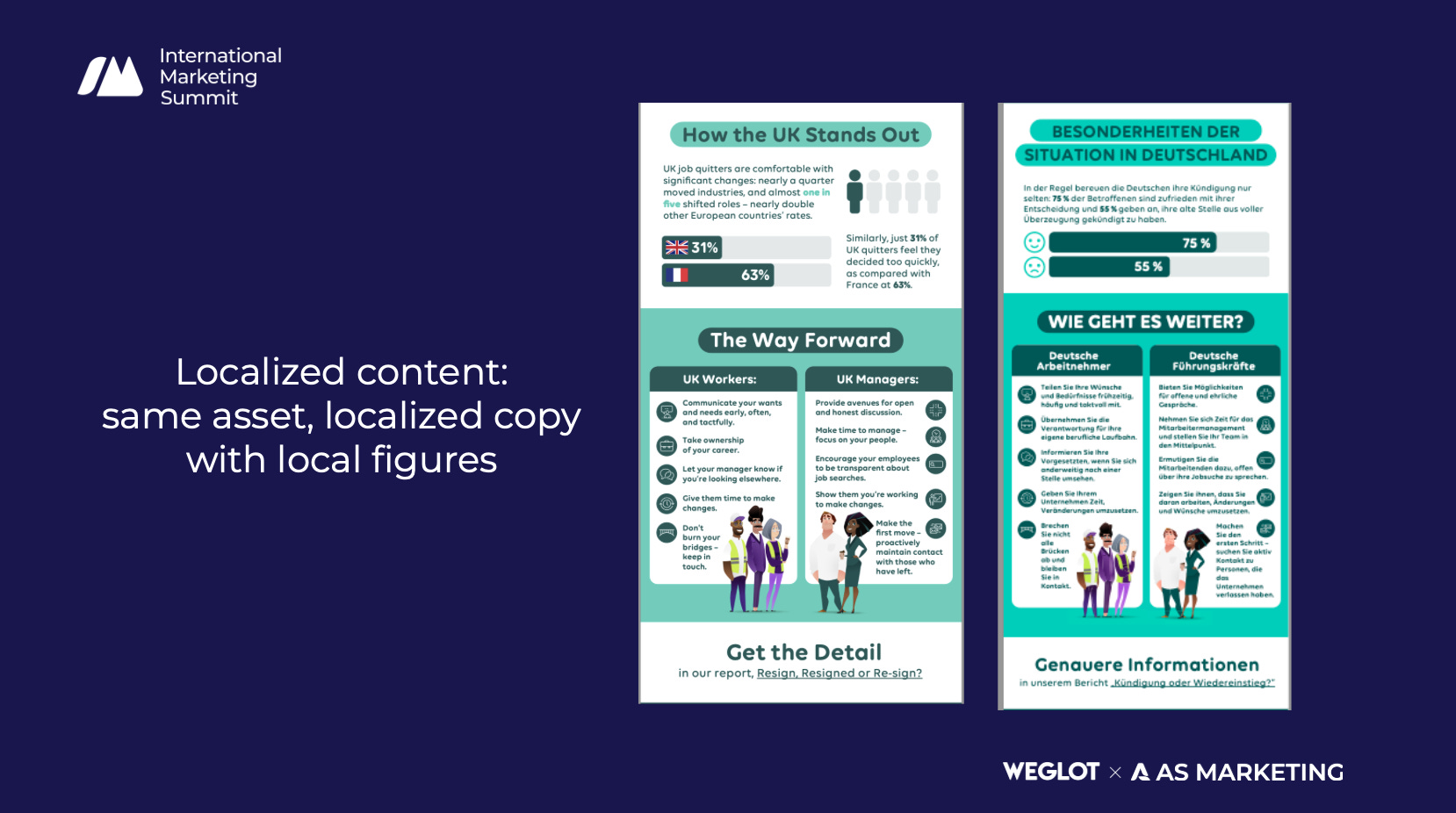
They use the same approach in social media. On LinkedIn in Germany, posts that lead with statistics and data drive significantly more click-throughs than story-led content. In the UK, visual-led and narrative content performs better. Same channel, same campaign, completely different content logic.
What this means operationally
Knowing this is one thing. Building a robust content operation that can execute it is another.
A few things Rémi has learned the hard way (so that you don’t have to):
Don’t use copywriters to proofread localized content. Their instinct is to rewrite, not to check. And using a talented content marketer to review a translation is a fast way to create frustration and bottlenecks – you’re asking them to do something beyond their niche, unless they have solid experience localizing in that language.
Localization and content creation are different skill sets, and treating them as interchangeable creates problems. In practice, UKG separates them: content marketers focus on top-of-funnel marketing campaigns, while bottom-of-funnel material (customer stories, product collateral) gets routed to the pre-sales team, who find it more relevant to their work anyway.
Proofread in context. UKG moved from reviewing translations sentence-by-sentence to reviewing them directly in InDesign, in the actual layout the reader will see. For a white paper or ebook, you can’t evaluate a localized piece of writing without understanding how it flows and how it appears visually. Structure and context matter as much as the words do.
Build your translation memory and glossary early. A lot of content reuses the same language: product names, brand terms, recurring phrases. A solid glossary means you decide once, not every time a new asset gets localized.
On AI: promising, but not there yet for culture
Rémi uses AI in his localization workflow for adapting copy tone, generating research references, exploring how a piece of content might be reframed for a different market. The results, he says, are interesting.
But he’s clear-eyed about the limit. AI can handle language. But it cannot yet handle the cultural logic of why a German audience needs the argument built differently from a British one. That structural, storytelling layer still requires human judgment from someone who not only speaks the language but understands how that culture receives information.
His expectation is that this will change within the next year or two. But for now, AI accelerates the process; it doesn’t replace the cultural expertise at the end of it.
The metric that matters most
UKG tracks the usual metrics: traffic, LinkedIn engagement, downloads, A/B test results comparing localized versus translated versions. The team found that localized content consistently outperforms, and this corresponds to what we shout from the rooftops: localizing properly gets you much further than expensive brand campaigns that aren’t grounded in on-field insights.
But the signal Rémi valued most is qualitative. Implementation partners and consulting firms across Europe have started telling UKG unprompted: you really sound like a local company. In a tech industry where most content defaults to English regardless of market, that kind of recognition is the verbal, marketing equivalent of an Oscar. And, he argues, it’s what genuine localization is actually trying to achieve.
Translation changes the words, but localization changes whether people feel spoken to.